Boundaries and neighbours
Who is responsible for a retaining wall on a boundary in Auckland?
This is the most common question we get that nobody in the Auckland market answers properly. It is also the question most likely to stall a project, because the answer changes who pays and who decides.
Work out who owns and pays for a wall on or near a boundary. SRW Auckland manages the whole project from the first site visit to the finished wall.
Source-led guidance
Published August 2026
Factual statements on this page are drawn from Auckland Council and MBIE published guidance. Neither organisation endorses SRW Auckland.
Before you read on. This page explains what determines the question. It is general information, not legal advice, and it does not resolve a dispute about a specific property. Where ownership or liability is contested, get advice from a property lawyer.
01 / The short answer
There is no single rule that says who owns a boundary retaining wall.
Responsibility is decided by a combination of factors: which property the wall physically sits on, which property it structurally supports, what the record of title, easements and covenants say, and what was agreed in writing when the wall was built or when the land was subdivided.
The Fencing Act 1978 that people often reach for is about boundary fences and their equal cost-sharing rules, and it does not settle retaining wall responsibility. A wall can sometimes be treated as a boundary fence where it also serves that dividing function, but assuming a fifty-fifty split because that is how fences work is a common and expensive mistake.
Because there is no single rule, the practical path is to gather the documents first and have the conversation second. A wall that is already in dispute is much harder to build.
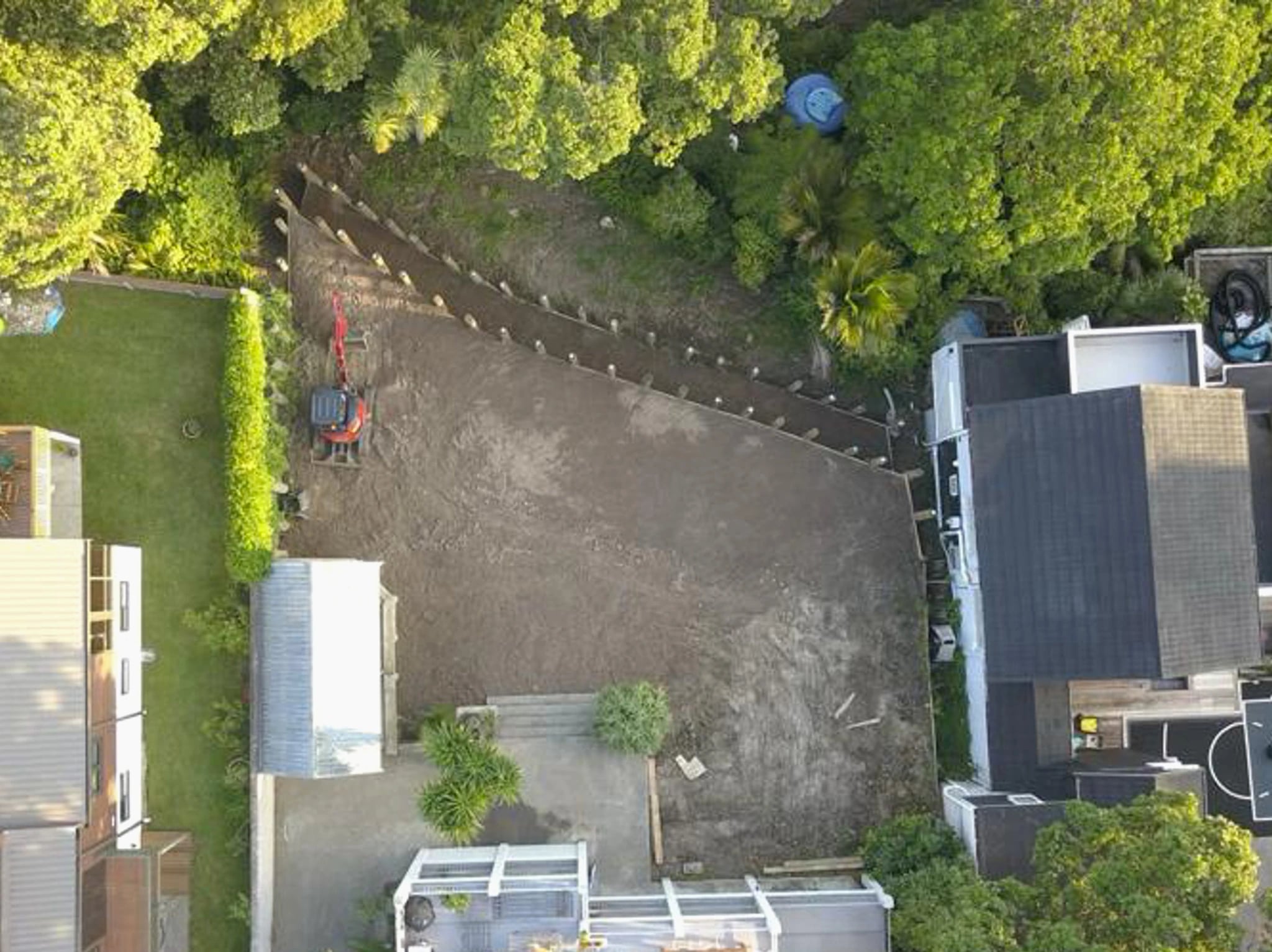
02 / What decides it
The questions that decide responsibility for a boundary retaining wall.
Work through five questions: where the wall sits relative to the legal boundary, which property is being supported, what the title documents record, what was agreed at the time, and whether a subdivision consent imposed any obligation.
- Where does the wall physically sit?
- Wholly on one property, straddling the boundary, or set back from it. A survey may be needed. What people believe the boundary is and where it legally sits are often different.
- Which property does the wall support?
- A wall usually retains the higher ground. The property that benefits from the retained ground is frequently, though not always, the one carrying responsibility.
- What does the record of title say?
- Easements, encumbrances, consent notices and covenants can record maintenance obligations or shared responsibility. The instrument that deals with this directly is a right of support easement, which sets out who repairs and maintains the wall and who pays. The record of title and a LIM report are the starting documents: a LIM shows what Council knows, rather than creating the obligation itself.
- What was agreed when it was built?
- A written agreement, a shared-cost arrangement, or a condition attached to an earlier build can settle it. Verbal agreements between previous owners rarely survive a change of ownership.
- Was it a condition of subdivision?
- Where land was cut and filled to create sections, retaining structures and their maintenance are often addressed in the subdivision consent or a consent notice on the title.
03 / Before you talk to the neighbour
What to gather before raising a boundary retaining wall with a neighbour.
Get the record of title, a LIM report, any subdivision or consent notices, and any earlier building consent documentation for the wall. Those four documents answer most of the question before anyone has an awkward conversation.
- Record of title for your property, including any easements, covenants and consent notices
- A LIM report from Auckland Council, which shows recorded consents and known site information
- Any building consent, producer statement or as-built records for the existing wall
- The subdivision consent, if the section was created by subdivision
- Photographs of the current condition, taken only from a safe position on your own property
- A survey, where the legal boundary position is genuinely unclear
04 / Practical reality
A boundary wall usually needs both owners on board even where one is responsible.
Even when responsibility is clear, building or replacing a boundary retaining wall normally requires access from both sides, agreement on the finished level, and cooperation during construction. That practical reality often matters more than the strict legal position.
Construction access is the usual sticking point. Excavating for a wall on the boundary frequently requires working from the low side, which may be the neighbour's property, and may temporarily affect their planting, paving or services.
Where a wall supports both properties, both owners have an interest in it being built properly. Framing the conversation around the shared risk of a failure is generally more productive than framing it around who is legally at fault.
SRW manages the practical side of this: sequencing that minimises disruption on the neighbouring side, and clear communication about what happens when. Legal responsibility remains a matter between the owners and their advisers.
05 / When it is failing
A failing boundary wall raises the same questions with less time to answer them.
If a boundary retaining wall is moving, cracking or leaning, the ownership question does not go away, but it should not delay making the site safe. Deal with immediate risk first and resolve responsibility alongside the technical work.
Keep people and vehicles away from both the top and the base of a wall showing movement. If there is immediate danger, contact emergency services and get urgent site-specific advice from an appropriately qualified professional.
Document the condition with dated photographs from a safe position. That record matters later, whether the conversation is with a neighbour, an insurer or Council.
Tell us where the wall sits.
Share the address and what is happening. We work out the pathway, engage whoever the project needs, and deal with Auckland Council where consent applies. If you already know what you want built, our Auckland retaining wall builders page covers how we work and where.
06 / COMMON QUESTIONS
Common questions about boundaries and neighbours in Auckland.
Is a retaining wall covered by the Fencing Act?
Generally not. The Fencing Act 1978 deals with boundary fences, and the shared-cost logic people apply to fences does not automatically carry across to a retaining wall. It is not absolute: a wall that also serves as the dividing structure between two properties can be treated as a fence, and where a fence sits on top of a wall the two parts can be treated differently. It is a question for a property lawyer on a specific wall, not something to settle from a website.
My neighbour's wall is holding up my land. Whose is it?
That depends on where it sits, what the title records and what was agreed. A wall that supports your land is not automatically yours, and one that sits on your land is not automatically your sole responsibility. Start with the record of title and the LIM.
Can I build a retaining wall right on the boundary?
It is possible, but it usually involves the neighbouring owner, may require access from their side, and can raise both building consent and Auckland Unitary Plan questions. Setting the wall back from the boundary sometimes simplifies the project considerably.
Do I need my neighbour's permission?
Permission is a separate question from consent. Auckland Council decides the regulatory question. Whether you need agreement from the neighbouring owner depends on ownership, access and what the title records. Both usually need to be sorted before work starts.
Who pays if the wall fails?
That depends on ownership, on any agreement in place, on insurance, and potentially on the cause of failure. It is a legal and insurance question rather than a construction one, and it is worth advice before money is spent.
Can SRW sort out the boundary question for me?
We work with the documents you gather and we sequence the construction to suit both properties. We do not give legal advice and we cannot determine ownership. Where it is contested, a property lawyer is the right person.
A clear place to start
Tell us where the wall sits.
Share the address, the situation and a short description. You do not need to know the wall system, consent pathway or engineering requirements.
Two short steps. We reply by email or phone.