After a storm
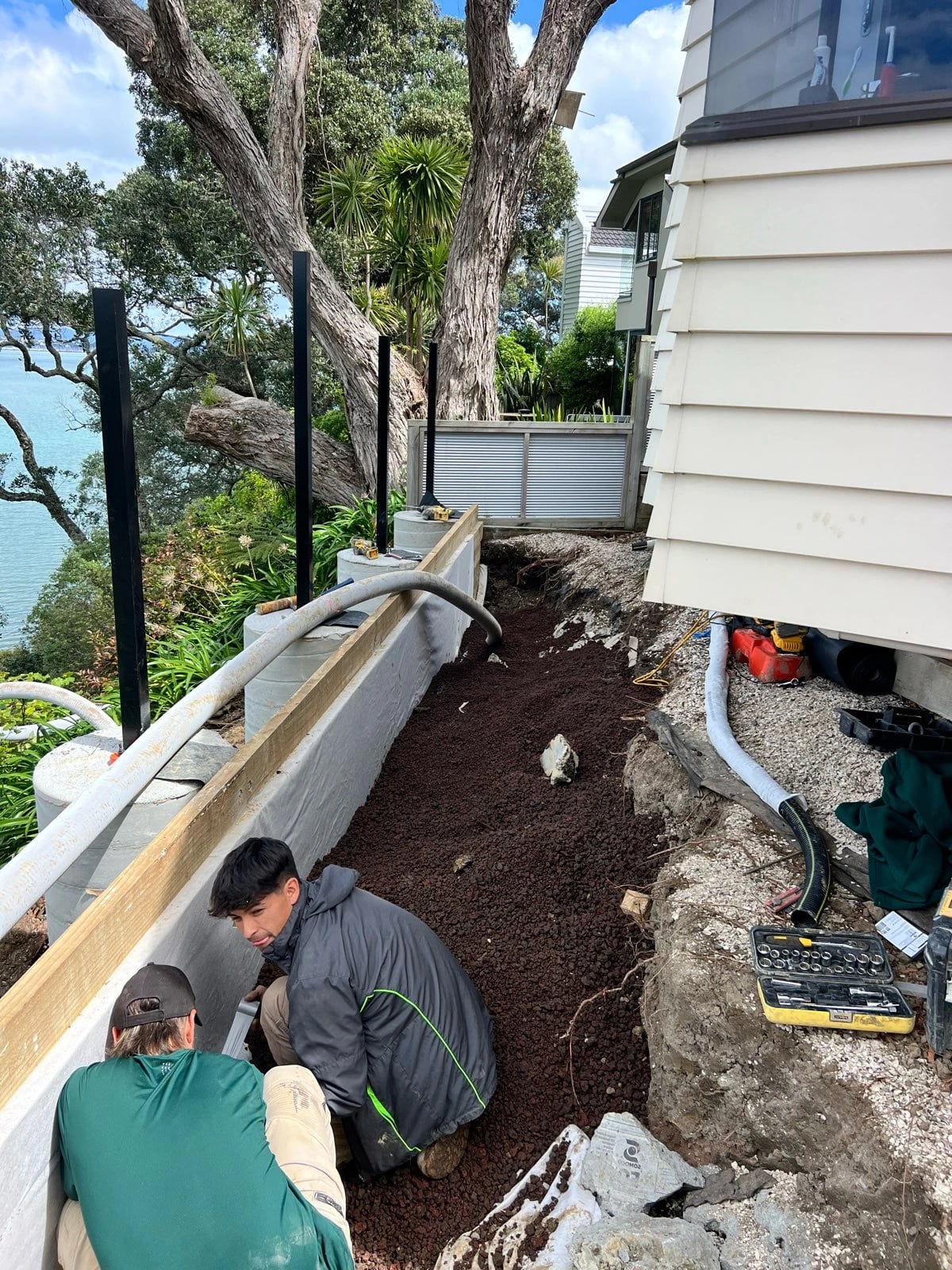
Checking a retaining wall after heavy rain in Auckland.
Sustained rain is when retaining walls are tested hardest, and when problems that have been developing quietly become visible. A short check afterwards, from a safe position, is worth doing.
Know what to look for after a storm and what to do about it. SRW Auckland manages the whole project from the first site visit to the finished wall.
Source-led guidance
Published August 2026
Factual statements on this page are drawn from Auckland Council and MBIE published guidance. Neither organisation endorses SRW Auckland.
Before you read on. Check from a safe position only. Do not stand at the base of a wall showing movement, do not walk on ground that has cracked or dropped, and do not excavate to investigate. If there is immediate danger, contact emergency services and seek urgent site-specific advice from an appropriately qualified professional.
01 / The short answer
Look for change, not for perfection.
The useful question after heavy rain is not whether the wall is perfect. It is whether anything has changed since before the rain. New cracking, new lean, new water paths and new ground movement are the signals worth acting on.
This is much easier if you have photographs from before. Taking a set of dated photographs of your walls while conditions are dry is a small job that makes every future check meaningful.
02 / The check
What to check on a retaining wall after a storm.
Check the face for new cracking or bulging, the top for new lean, the ground behind for cracking or dropping, the ends for erosion, and the base for water discharging or ground washing out.
- The face
- New cracks, cracks that have widened, blocks that have stepped or moved relative to each other, timber that has bowed or split.
- The top
- A gap opening behind the top of the wall. A fence or planting above the wall going out of plumb is often the first visible sign.
- The ground behind
- Cracking in lawn, paving, paths or driveway behind the wall. A step or depression forming parallel to the wall.
- The ends
- Erosion or washout at either end, which usually means water is running around the wall rather than through the drainage.
- The base
- Water discharging, ground softening, or material washing out from the toe of the wall.
- Water paths
- Where water actually went during the rain. Downpipes discharging near the wall, paving directing flow toward it, or an overflow running across the retained ground.
03 / What to do
What to do if something has changed after heavy rain.
Keep people and vehicles clear of the top and base, stop loading the retained ground, photograph what you can see from a safe position, contact your insurer, and arrange a site assessment.
- Keep people, pets and vehicles away from the top and the base of the wall
- Stop parking, storing material or driving on the ground above it
- Photograph the change from a safe position, with dates, including a wide context shot
- Note when the change appeared relative to the rain
- Redirect obvious surface water away from the wall if it is safe to do so
- Contact your insurer, particularly following a declared weather event
- Arrange a site assessment rather than waiting to see whether it settles
04 / Why rain does it
Why heavy rain is what exposes a retaining wall problem.
Saturated soil pushes much harder against a wall than drained soil, so a wall with inadequate drainage sees loads during sustained rain that it never sees in normal conditions. Rain does not usually cause the underlying problem; it reveals it.
Auckland's clay soils hold water and drain slowly, so pressure can build and stay high for days after the rain stops. Walls sometimes move after the weather has cleared.
This is also why a wall can perform for many years and then move suddenly. The drainage may have been slowly failing for a decade before a wet enough period arrived to expose it.
Tell us what changed.
Share the address and what is happening. We work out the pathway, engage whoever the project needs, and deal with Auckland Council where consent applies. If you already know what you want built, our Auckland retaining wall builders page covers how we work and where.
05 / COMMON QUESTIONS
Common questions about after a storm in Auckland.
My wall is wet but nothing has moved. Should I worry?
Water on the face is not automatically a problem, but it does indicate water is reaching the wall. It is worth photographing so you have a baseline, and worth checking where the water is coming from.
How long after rain should I check?
Both during and after. Some things are only visible while it is raining, particularly where water is running. Others develop over the following days as pressure stays high in saturated ground.
Should I contact my insurer before or after getting it looked at?
Contact them early. Policies differ on notification requirements and on what is covered, particularly after a declared weather event, and dated photographs taken early are useful evidence either way.
Can I put a tarpaulin over the ground behind the wall?
Reducing water entering the retained ground can help in the short term, if it can be done safely and without standing on ground that may be unstable. It is a holding measure, not a fix.
Is a small amount of new cracking normal?
New cracking is a change, and change is the thing worth acting on. Whether it is significant depends on the wall, the pattern and what is behind it, which is a site question.
A clear place to start
Tell us what changed.
Share the address, the situation and a short description. You do not need to know the wall system, consent pathway or engineering requirements.
Two short steps. We reply by email or phone.